
One-Stop Cold Storage Solutions: Design, Manufacture & Support
One-Stop Cold Storage Solutions: Design, Manufacture & Support
Category: Sandwich Panels
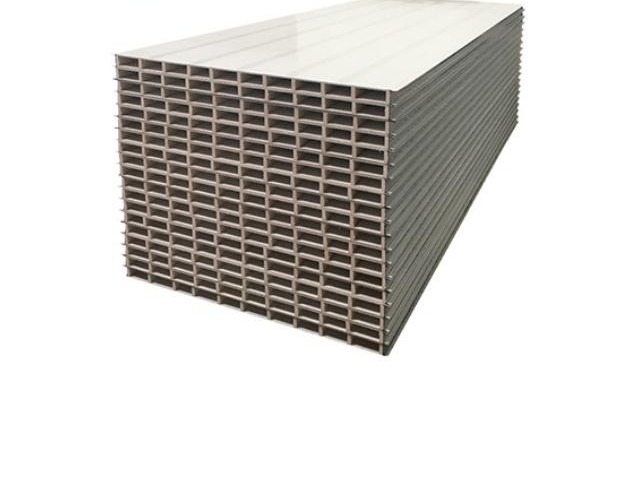
The Hollow Magnesium Oxide Cleanroom Panel is engineered for partition duty where weight and handling govern: magnesium oxide board facings formed around a hollow core structure, producing panels substantially lighter than solid-core equivalents while retaining MgO’s hard, stable, cleanable surface. The result is a cleanroom partition system that installs quickly, loads support structures minimally, and still delivers the flush-wall geometry controlled environments require.
The panel serves cleanroom partition systems where full solid-core performance is unnecessary: internal zoning walls dividing clean areas from support spaces, corridor walls in laboratory buildings, partition suites within larger controlled halls, and cleanroom retrofits on upper floors or raised access structures where weight is restricted. It is also the economical choice for partition networks in electronics assembly, packaging and inspection environments – rooms that need cleanroom surface quality without the fire or insulation demands of process-critical zones.
Partition walls and envelope walls do different jobs, and specifying them identically wastes money and effort. An exterior or freezer wall must block heat flow and weather; a partition must divide space, present cleanable surfaces and hold geometry – insulation and mass contribute little to its duty. Hollow-core construction applies material exactly where the job needs it: MgO facings carry surface quality, impact resistance and cleanability, while the hollow interior removes core mass that serves no partition function. The benefits compound through installation – lighter panels lift and position faster, support structures can be lighter, and logistics through existing buildings stay manageable, which matters enormously in renovation cleanrooms where every panel travels through corridors and doorways by hand. The engineering check is confirming the duty: where partitions also need fire compartmentation or thermal separation, solid mineral cores take over; where they divide clean space from clean space, hollow MgO delivers the required performance at lower weight and cost. Right-sizing the construction to the duty is how cleanroom projects stay both compliant and economical.
MgO facings are formed around the hollow core structure under controlled conditions; panels are inspected for surface flatness, facing integrity and dimensional accuracy before packing. Arteco prepares partition layouts with joint details, coordinates panels with doors and service penetrations, and specifies support framing so partition systems install straight and stay true.
Hollow construction removes most core mass, reducing panel weight substantially – typically by half or more versus solid mineral cores. The saving matters for raised floors, mezzanines and renovation logistics.
Yes – MgO facings provide rigid, impact-resistant surfaces, and support framing is specified per partition height and use. Panels meet standard cleanroom wall performance for partition applications.
Where partitions must also provide fire compartmentation, acoustic separation or thermal insulation, solid mineral cores are specified. We review each wall’s duty during layout design.
Fixings for light fixtures and fittings attach through the facings into support framing; heavy wall-mounted equipment is coordinated with framing positions in the layout.
MgO board is moisture-stable when properly finished and jointed; joint details are specified for the room’s humidity regime during design.
Lightweight partition systems must be engineered for their actual duty, because lightness is an advantage only when strength follows the design. The engineering starts with partition function: walls dividing clean areas need surface quality and geometry; walls adjacent to plant areas may need impact resistance; walls carrying mounted equipment need fixing support. Height determines lateral stability requirements, which set support framing spacing and top-fixing details. Door positions concentrate use – frames need reinforcement and clearances planned for traffic. Services passing through partitions require penetration details that maintain the wall’s surface integrity. Each of these inputs shapes the partition specification: framing layout, panel fixing schedule and component selection. Partitions engineered this way stay straight and true through years of use; partitions built without the analysis eventually show it in bowed planes and loose fittings. We prepare partition layouts with the full engineering detail for every cleanroom partition system we supply, so lightness never comes at the cost of performance.
Fixing positions are coordinated with support framing so loads transfer properly; heavy equipment receives dedicated framing details drawn into the partition layout.
| Specification | Value |
|---|---|
| Surface Material | Magnesium oxide board |
| Core Structure | Hollow |
| Application | Cleanroom partitions |