
One-Stop Cold Storage Solutions: Design, Manufacture & Support
One-Stop Cold Storage Solutions: Design, Manufacture & Support
Category: Sandwich Panels
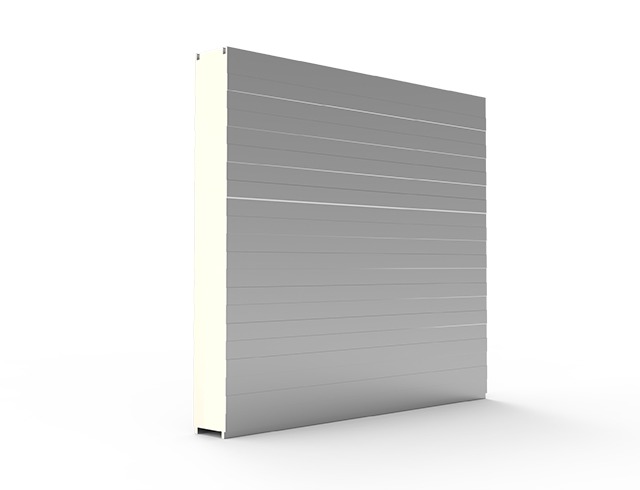
The 100mm Cold Room Panel is the industry’s default choice for frozen storage: thick enough to hold -18°C to -25°C rooms efficiently in most climates, and standardized enough to be the reference specification across cold chain construction. With a polyurethane core conducting heat at 0.022 W/mK, the panel keeps freezer heat gain low, stabilizes temperature through door openings and defrost cycles, and protects product quality across storage campaigns measured in months rather than days.
The 100mm panel serves mainstream frozen storage across industries: frozen food distribution warehouses, supermarket chain freezer rooms, meat and seafood frozen storage, ice cream storage rooms, bakery frozen ingredient stores, catering freeze rooms and pharmaceutical frozen suites. It is the workhorse specification for facilities that store at -18°C to -25°C in temperate climates, and the starting point our engineers use when scoping freezer projects before adjusting for extreme ambient conditions or deeper temperature duties.
Most frozen food chains converge on -18°C storage because it arrests microbial growth, slows enzymatic degradation and preserves texture across long campaigns – the temperature at which frozen quality economics work. Maintaining it reliably imposes real demands on the envelope: the wall faces a 40–55 degree differential against ambient, and every watt of heat that penetrates must be pumped out continuously by the refrigeration system, which also has to handle the moisture that infiltrating air brings. A 100mm polyurethane wall at 0.022 W/mK holds this duty with a U-value near 0.22 W/(m²·K), keeping load low enough that standard equipment selections hold temperature with reserve. Where ambient design conditions exceed roughly 35°C, or rooms run colder than -25°C, our calculations may recommend 150mm for margin – but for the majority of the world’s frozen warehouses, 100mm remains the engineered standard, proven across decades of cold chain construction.
Continuous lamination holds core density at 40 kg/m³ and conductivity at specification; panels are cut to length, inspected for dimensional accuracy and facing bond, and packed by position. Arteco provides heat-load calculations validating thickness per room, layout drawings with joint and junction details, and coordination with freezer doors and refrigeration equipment so the room performs as one system.
In temperate climates, yes. Where summer ambients exceed roughly 35°C, our heat-load calculation may recommend 150mm to preserve efficiency and temperature stability. We quantify the trade-off before you order.
Deeper duty at -30°C and below is better served by 150–200mm panels, which control heat gain and frost risk at the larger temperature differential. We specify thickness per room temperature.
Insulated floor systems matched to the room temperature, with load spreading for pallet or forklift traffic. We detail the wall-to-floor junction to keep the envelope continuous and frost-protected.
Low envelope heat gain means the room recovers quickly after defrost and door openings. The refrigeration control strategy is sized with this recovery requirement in mind during selection.
Yes. Panels join mechanically, so additional freezer bays attach with matching panels and the envelope reseals. Panel schedules are retained for seamless future expansion.
Frozen storage quality depends on details beyond temperature setpoint. Door discipline governs frost formation: every opening admits humid air that freezes onto the evaporator, so strip curtains or rapid doors reduce the load on defrost systems. Airflow must reach every pallet position – stacking patterns that block return air create warm pockets where product temperature drifts. Defrost scheduling should complete well before peak loading periods so the room recovers fully. Floor interfaces need attention in freezers: heated floor protection or insulated construction prevents frost heave that can damage structure over years. Monitoring with alarms protects stock against equipment faults. Our freezer room layouts address each detail – airflow paths, door arrangements, floor specification and monitoring points – because frozen product quality is protected by the room’s design long before refrigeration is switched on.
Monitoring and alarm systems can be included in the room package, with sensors positioned to represent actual storage conditions and alerts configured to your operating procedures.
| Specification | Value |
|---|---|
| Panel Thickness | 100mm |
| Standard Facings | Steel sheet / Galvanized sheet / Stainless steel |
| Core Material | PU (Polyurethane) |
| Thermal Conductivity | 0.022 W/mK |
| Standard Length | 2m-12m |
| Effective Width | 1000mm |