
One-Stop Cold Storage Solutions: Design, Manufacture & Support
One-Stop Cold Storage Solutions: Design, Manufacture & Support
Category: Sandwich Panels
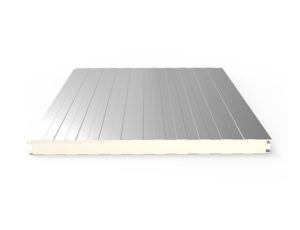
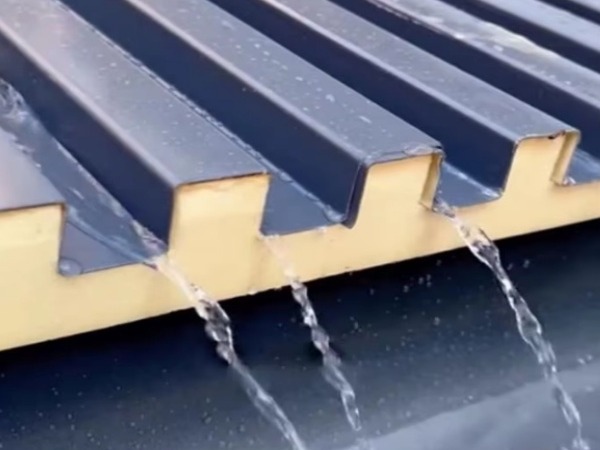
The Aluminum PIR Great Wall Panel for Thermal Insulation is specified with one purpose stated first: stopping heat flow through walls. Its polyisocyanurate core conducts heat at just 0.022 W/mK class performance – among the lowest conductivities available in construction materials – while aluminum facings protect the core and the Great Wall profile stiffens each panel for true, stable wall planes. The panel serves walls and facades where energy performance is the design driver: buildings with continuous temperature control, projects pursuing energy certification, and retrofit programs where envelope heat loss is being engineered out rather than paid for forever.
The panel serves buildings where envelope efficiency converts directly to money or compliance: temperature-controlled storage and processing facilities running refrigeration around the clock, conditioned warehouses in extreme climates, manufacturing plants with HVAC-dominated energy bills, buildings pursuing energy performance certification, and retrofit programs reducing carbon footprint through envelope upgrades. It also fits projects in regions with emerging energy codes, where specifying high-performance envelopes now avoids costly remediation later.
Every wall conducts heat continuously, and in conditioned buildings that conduction is billed forever: in summer, heat entering through walls drives cooling energy; in winter, heat escaping drives heating. Insulation interrupts the flow at installation and keeps interrupting it every hour thereafter, with no moving parts, no maintenance and no operator attention. The calculation that matters is simple – wall area, temperature difference, conductivity and time – and it consistently shows that envelope insulation pays back from energy savings alone, often within a few years, then continues paying for decades. PIR’s advantage in that calculation is conductivity: at 0.022 W/mK class performance, each millimeter of core blocks roughly twice the heat of common fibrous insulation, so target U-values are reached in thinner build-ups – less space lost, less structural load, cleaner details. Aluminum facings contribute on the timescale insulation deserves: the envelope must survive decades to deliver decades of savings, and aluminum’s corrosion resistance keeps the thermal system physically intact where lesser facings would degrade. Specifying this panel is therefore not a material choice but an energy decision expressed as construction – one whose returns our engineers quantify for every project before purchase.
Continuous lamination holds core density and conductivity at specification; panels are profiled, cut and inspected for dimensional accuracy before packing. Arteco prepares the thermal specification – U-value targets, thickness selection and junction details for thermal continuity – alongside facade layouts and fixing specifications, and provides the performance documentation energy-focused projects require.
U-value follows core thickness and construction details; at 50mm with PIR conductivity in the 0.022 W/mK class, walls reach strong insulation levels. We calculate the exact value for your construction during design.
Share the building’s climate data, operating temperatures and energy goals; we run the heat-transfer calculation and recommend the construction that meets the target, quantifying savings.
Joint geometry and detailing are designed to maintain insulation continuity; corners, junctions and penetrations receive drawn details so the assembled wall performs as calculated.
Yes – thermal performance data and product documentation are provided in formats suitable for energy modeling and certification processes.
In very hot or cold climates, thicker constructions may be required to meet energy targets. Our calculation compares options so the selected build-up satisfies the target without overbuilding.
Energy-focused projects increasingly require documented envelope performance – for code compliance, certification schemes or corporate sustainability reporting. The documentation chain starts with material data: core conductivity and facing specifications that define the panel’s thermal behavior. Assembly calculations follow: U-values computed for each wall construction from layer properties, including junction corrections where detailing affects performance. These feed the building energy model, which quantifies annual consumption against the applicable standard or target. Each link must be traceable – reviewers follow the numbers from regulation to material datasheet. Our thermal documentation provides exactly this chain: conductivity data, construction U-value calculations and junction details, formatted for energy modeling input. Projects pursuing certification or code compliance can therefore build their evidence file from manufacturer documentation rather than reconstructing it, which is how envelope specifications survive technical review without rework.
Thermal conductivity data, U-value calculations and construction details are provided in standard formats suitable for energy modeling software and certification submissions.
| Specification | Value |
|---|---|
| Panel Thickness | 50mm |
| Surface Material | Aluminum |
| Core Material | PIR (Polyisocyanurate) |
| Application | Thermal insulation and wall cladding |