
One-Stop Cold Storage Solutions: Design, Manufacture & Support
One-Stop Cold Storage Solutions: Design, Manufacture & Support
Category: Sandwich Panels
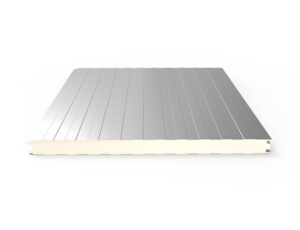
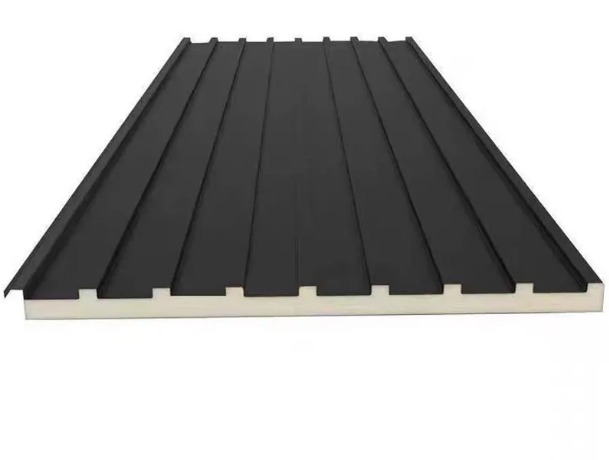
The PIR Sandwich Panel with Aluminum Alloy Finish is built around surface quality: aluminum alloy facings finished to a smooth, consistent standard that holds color and sheen across large facade areas, wrapped around a polyisocyanurate core that insulates at 0.022 W/mK class performance. Where patterned profiles create texture, this panel’s value is the opposite – clean planes, even finish and precise edges that let buildings read as premium from any distance. The Great Wall joint profile keeps panels aligned and the envelope continuous at 50mm thickness.
The panel serves projects where finish quality is part of the brief: corporate facilities and headquarters buildings, food and pharmaceutical plants hosting customer and audit visits, showrooms and visitor-facing logistics buildings, hotels and commercial structures with insulated walls, and cold storage facilities whose owners treat appearance as brand equity. It also fits renovation projects where an existing building needs a flawless new skin – the aluminum finish renews facades completely, with no site-applied finishes to age unevenly.
A facade’s appearance depends on three things that must all survive manufacturing: the metal’s surface preparation, the coating’s formulation and application, and the handling that follows. Aluminum facings begin with controlled surface treatment that gives coatings something to bond to; finish layers are applied in factory conditions – consistent thickness, cured properly, inspected – rather than sprayed on scaffolding in weather; and finished panels are protected through fabrication, packing and transport so the surface that arrives is the surface that was produced. Each step matters because finish failures rarely look like defects on day one: they appear as uneven gloss in raking light, color drift between wall sections, or early chalking on sun-facing elevations. Factory discipline prevents those outcomes at the source. For owners, the practical result is facades that photograph well for marketing, impress auditors and visitors, and still look uniform a decade later – appearance maintained by manufacturing quality rather than maintenance budgets.
Facing sheets are treated, finished and bonded to the PIR core under controlled lamination; panels are inspected for surface quality, profile alignment and dimensional accuracy before packing with surface protection. Arteco prepares facade layouts with joint spacing planned for visual rhythm, and coordinates corners, trims and penetrations so the finished installation reads as one continuous, precisely detailed surface.
Standard color palettes and gloss levels cover most architectural requirements; specific color matching is reviewed during order. Samples are available for selection.
Aluminum finishes generally hold color and gloss longer because the metal itself resists corrosion and coating systems for aluminum are engineered for exterior durability. In coastal and high-UV sites the difference is most pronounced.
Yes – for chill and temperature-controlled duty at 50mm; thicker constructions serve deeper cold applications. We specify thickness from room temperature and climate.
Individual panels can be replaced if damaged; factory finishing means replacements match the original surface standard, unlike site touch-up repairs on painted systems.
Periodic washing with water and mild detergent removes environmental deposits. No repainting or refinishing cycle is required, which is the finish’s principal lifecycle advantage.
Large facade areas amplify small imperfections – a joint variation invisible on a small wall becomes a visible wave across a hundred meters. Flawless results therefore come from controlling the factors that create variation. Substrate alignment is verified before panels install, because no panel system flattens a crooked structure. Joint spacing is planned in the layout so shadow gaps run consistent across the full elevation. Panel orientation follows the facade’s dominant sight lines, keeping pattern rhythm regular. Fixing sequences are specified to avoid oil-canning – the subtle drumming distortion that appears when panels are stressed during installation. Finally, the finished facade is reviewed in raking light, when surface irregularities are most visible, before scaffolding comes down. Installers who control these factors produce facades that read perfectly at every distance; our layout and installation guidance documents each control point for finish-critical projects.
Yes. For appearance-critical projects we can provide supervised installation, verifying alignment, joint consistency and surface quality as the facade progresses.
| Specification | Value |
|---|---|
| Panel Thickness | 50mm |
| Surface Material | Aluminum alloy |
| Core Material | PIR (Polyisocyanurate) |
| Joint System | Great Wall profile |