
One-Stop Cold Storage Solutions: Design, Manufacture & Support
One-Stop Cold Storage Solutions: Design, Manufacture & Support
Category: Sandwich Panels
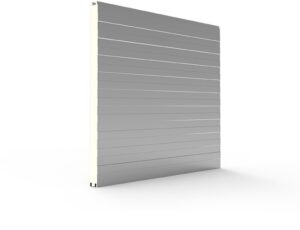
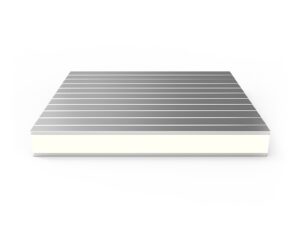
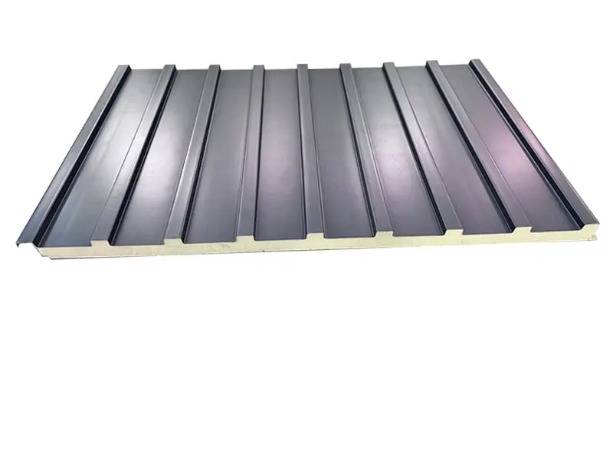
The Aluminum PIR Insulated Great Wall Panel pairs the distinctive vertical-rib “Great Wall” profile with one of insulation’s best-performing cores: polyisocyanurate foam conducting heat at just 0.022 W/mK class performance, wrapped in aluminum alloy skins that shrug off corrosion. The 50mm panel insulates walls and facades with genuine cold-room-grade efficiency while presenting deep shadow lines that read as architecture rather than industrial sheeting. Tongue-and-groove joint systems keep the envelope continuous, so the panel performs as well as it looks across storage buildings, processing facilities, commercial facades and temperature-controlled construction.
The panel serves buildings where insulation and appearance are specified together: cold storage facilities visible from public roads, food and beverage plants with customer-facing walls, logistics buildings in corporate parks, commercial facades over insulated construction, and temperature-controlled processing facilities whose owners want durable good looks. Aluminum facings make the panel a natural fit for coastal projects – ports, seafood plants and marine-adjacent warehouses – where salt atmosphere punishes lesser metals. Retrofit facades over existing insulated walls also use the panel to renew appearance while retaining or upgrading thermal performance.
Steel facings dominate sandwich panel construction because steel is strong and economical – but steel’s weakness is corrosion once its coating is cut, scratched or weathered through. Aluminum behaves differently: its oxide layer forms naturally and self-repairs, so the metal protects itself rather than depending entirely on applied coatings. In salt air, chemical atmospheres and high-UV climates, aluminum facings hold appearance and integrity longer, with less maintenance over the building’s life. The trade-off – material cost and slightly lower stiffness – is managed by the Great Wall profile itself: the deep ribs stiffen each panel, so aluminum’s rigidity deficit disappears in the installed wall. The combination is therefore not just aluminum plus foam; it is aluminum engineered into a geometry where it performs structurally while contributing its corrosion advantages. For owners calculating lifetime cost rather than first cost, that combination often wins – particularly where repainting steel facades would otherwise join the maintenance schedule every few years.
Aluminum facing sheets are profiled, treated and bonded to the PIR core under controlled lamination; panels are inspected for profile accuracy, facing bond and dimensional consistency before packing. Arteco prepares facade layouts with joint detailing, corner and trim coordination, and fixing specifications matched to the support structure, so the finished wall installs true and weathers cleanly.
Coastal sites, chemical or marine atmospheres, high-UV climates and buildings where facade maintenance access is difficult. For standard inland environments, steel facings remain cost-effective – we advise based on your site exposure.
For chill duty and temperature-controlled spaces, yes; freezer rooms typically require thicker construction. We calculate the requirement from room temperature and climate during selection.
Joint profiles and corner trims complete the system; layouts detail each condition so water sheds off the facade and joints stay tight through thermal movement.
Aluminum facings accept standard finish palettes; color selection is confirmed during order review to coordinate with existing structures or corporate identity.
Periodic cleaning with water and mild detergent keeps appearance fresh; aluminum’s self-protecting oxide means no repainting cycle, which is the principal maintenance saving over painted steel.
Coastal construction imposes the harshest atmospheric service on building envelopes, and facades should be specified accordingly. Aluminum alloy facings are the foundation – their oxide layer resists salt attack where coated steel degrades – but coastal specification extends beyond metal selection. Joint and trim materials must match the facings’ corrosion class, because a stainless panel with mild-steel fixings fails at the fixings. Drainage details should shed salt-laden water cleanly rather than holding it against surfaces. Maintenance access deserves planning too: coastal facades benefit from periodic rinsing, and designs that allow easy washing stay cleaner longer. Fixing systems are specified for both corrosion and wind, since coastal sites combine salt air with storm exposure. We document each of these details for coastal projects, because envelope longevity in marine service is engineered deliberately – not inherited from standard inland specifications.
Periodic rinsing with fresh water removes salt deposits; no repainting is required. We specify rinse access in the facade design so maintenance remains simple through the building’s life.
| Specification | Value |
|---|---|
| Panel Thickness | 50mm |
| Surface Material | Aluminum alloy |
| Core Material | PIR (Polyisocyanurate) |
| Fire Rating | B1/B2 |
| Joint System | Tongue and groove |