
One-Stop Cold Storage Solutions: Design, Manufacture & Support
One-Stop Cold Storage Solutions: Design, Manufacture & Support
Category: Sandwich Panels
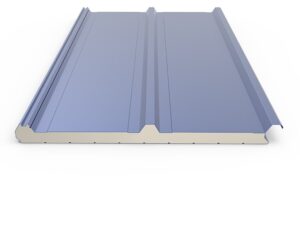
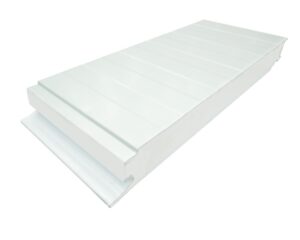
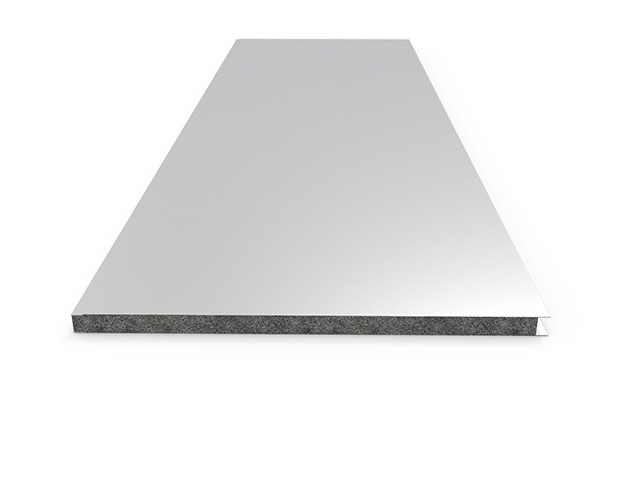
The 100mm EPS Sandwich Wall Panel pushes expanded polystyrene insulation into territory usually reserved for costlier foams: at 100mm thickness the core delivers thermal resistance suitable for genuinely cold spaces – chill rooms, cool stores and lightly frozen rooms – while retaining the cost advantage that makes EPS the budget benchmark of insulated construction. Steel facings, effective width 1000mm and lengths from 2m to 12m complete a panel that brings engineered cold storage within reach of projects where foam-core budgets do not close.
The panel serves cold projects built around cost discipline: agricultural cold stores for fruit and vegetable campaigns, cooperative storage facilities serving growing regions, cool rooms in food markets and distribution sheds, temperature-controlled packing facilities, and entry-level cold chain infrastructure in developing markets. It also fits industrial buildings needing insulated zones at modest temperature differentials. Where projects evolve toward deeper freezing, facilities can add supplementary insulation or migrate critical rooms to foam panels while retaining EPS construction elsewhere – the panel family makes mixed specifications coherent.
Insulation economics follow a simple relationship: conductivity sets efficiency per millimeter, and thickness multiplies it. PU foam’s 0.022 W/mK means less material achieves a given resistance; EPS’s higher conductivity means more material is needed – but EPS material costs so much less per unit volume that thicker EPS often undercuts thinner foam on total installed cost. At 100mm, an EPS wall reaches thermal resistance that serves real cold duty: chill rooms hold temperature with standard refrigeration packages, and energy consumption stays predictable across storage campaigns. The engineering check is always project-specific – we calculate heat load from room dimensions, target temperature, ambient climate and door usage, then compare EPS and foam constructions on both capital and operating cost. Frequently the 100mm EPS wall wins that comparison outright; where it does not, the numbers show exactly why. That is how cold storage expands into markets and applications that premium insulation would exclude.
EPS cores are cut to density specification and bonded to facings under controlled pressure; panels are inspected for adhesion, dimensional accuracy and edge quality before packing by position. Arteco prepares heat-load calculations, layouts with junction details and door coordination, and supplies complete room packages including refrigeration equipment where required.
Yes, in typical climates – this is the panel’s core duty. We verify with a heat-load calculation for your ambient conditions and door usage before confirming the refrigeration selection.
For occasional or mild frozen duty it can serve; for continuous -18°C operation we recommend thicker construction or PU/PIR panels. The right choice follows from the heat-load calculation for your specific room.
Heat gain through 100mm EPS exceeds an equivalent foam wall, so energy use is somewhat higher – the trade-off against lower construction cost. We quantify both sides for your project so the decision is made with real numbers.
EPS performs for decades when kept dry behind intact facings and sealed joints. Maintenance focuses on joint sealants and facing condition, as with all sandwich panel construction.
Yes. Panels join mechanically, so additional bays attach with matching panels. Panel schedules are retained for future extensions and repairs.
Cold chain development programs – agricultural cooperatives, regional distribution networks, developing-market infrastructure – succeed when construction cost aligns with the economics the facilities must support. EPS panel construction serves exactly this territory: capital outlays that produce viable cold storage at scales premium insulation would price out of existence. The development logic runs through every decision: room sizes matched to actual produce volumes rather than speculative capacity; refrigeration sized to calculated loads with practical margins; panel thickness engineered per room temperature rather than standardized upward. Programs built this way reach financial sustainability because their fixed costs allow it – and sustainable facilities expand, which is how cold chains actually develop. We support development programs with the same engineering discipline as commercial projects: heat-load calculations, layouts and equipment matching, delivered at the cost point development economics require.
Yes. Standardized room designs replicate across sites with local adaptation; we provide the design package, panel supply and installation guidance for programs of any scale.
| Specification | Value |
|---|---|
| Panel Thickness | 100mm |
| Core Material | EPS (Expanded Polystyrene) |
| Standard Length | 2m-12m |
| Effective Width | 1000mm |