
One-Stop Cold Storage Solutions: Design, Manufacture & Support
One-Stop Cold Storage Solutions: Design, Manufacture & Support
Category: Condensing Units
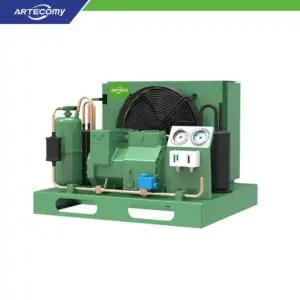
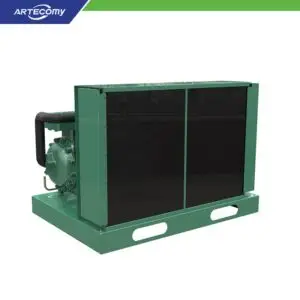
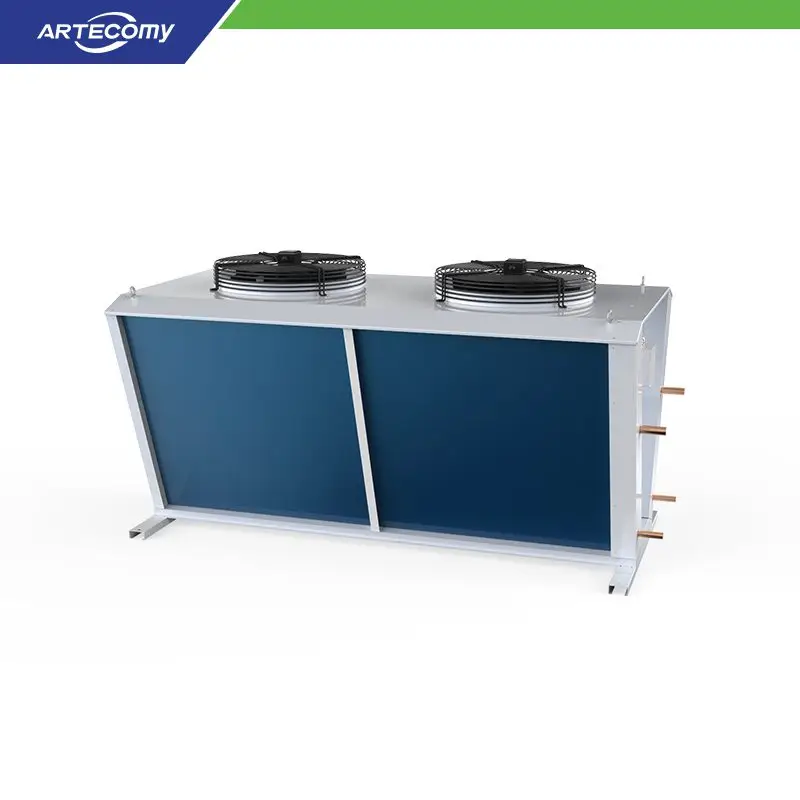
The High-Efficiency Air Cooled Condenser is a large-format heat rejection unit built around an optimized triangular tube layout and side-inlet airflow design. With 120–180 m² of heat transfer area and capacity from 30 to 50 kW, it serves medium and large refrigeration systems in cold storage warehouses, food processing plants and industrial cooling installations. Inner-grooved copper tubes and corrugated aluminum fins raise the heat exchange coefficient on both the refrigerant and air sides, so the unit rejects more heat per square meter of footprint than conventional flat-fin designs.
This condenser is engineered for systems where heat rejection capacity and energy efficiency both matter. Typical deployments include multi-room cold storage warehouses with centralized condensing, food processing facilities running freezing and chilling lines, beverage and dairy plants, logistics hubs and industrial process cooling. The high transfer-area design is especially valuable in hot climates, where maintaining condensing pressure directly controls compressor power consumption and product temperature stability. Retrofit programs replacing older, oversized or fouled condensers often reduce fan energy while recovering design capacity by switching to this triangular-layout platform.
Condenser performance is set by three exchanges: refrigerant condensing inside the tube, conduction through the tube wall and fin, and air sweeping heat away from the fin surface. The triangular tube layout staggers each row so air passing the first row strikes the tubes of the next row directly, keeping the entire coil face thermally active instead of allowing air to channel through gaps. Inner grooves on the tube bore trip the refrigerant film as it condenses, sustaining high heat flux. Corrugated fins continuously restart the air boundary layer, which is the main thermal resistance on the air side. Combined, these details let the unit reject the same heat at lower air volume – meaning smaller fans, less noise and lower electricity use across thousands of operating hours per year.
Coils are fabricated with precision tube bending, mechanical expansion into fins and jig-verified geometry, then pressure-tested and leak-checked before assembly into the frame. Each completed condenser undergoes final inspection against its rated duty. Arteco matches the condenser to compressor capacity, refrigerant type and design ambient during selection, and provides installation drawings covering clearances, airflow direction, vibration isolation and drainage.
It covers medium cold storage installations such as 500–2000 m³ freezer warehouses, multi-room chill facilities and food processing lines with several simultaneous cooling duties. Our engineers confirm the match against your total refrigeration load and design ambient temperature.
Maintenance access is unchanged – coil faces remain open for cleaning – but because the layout extracts more heat per pass, the unit tolerates mild fouling better than sparse layouts before capacity drops. Regular coil washing keeps efficiency at design level.
The coil is rated for R449A in addition to R404A, R507A and R410A, which supports projects transitioning under refrigerant regulations. Circuit components can be confirmed for the specific refrigerant during order review.
Yes. The 45 bar circuit rating and high transfer area provide margin for high condensing temperatures. We select the coil and fan combination at your site’s extreme ambient so capacity holds through summer peaks.
A high-efficiency condenser delivers its rated performance only when installed to support it. Airflow clearances must be preserved on every face – restricted inlet or discharge space raises condensing pressure and erases the design advantage. The side-inlet configuration should face the prevailing cool air direction where site layout allows, and discharge air must route away without recirculating. Line sizing between compressor and condenser follows the refrigerant charge and routing length, with oil return verified for vertical risers. Vibration isolation protects both structure and piping, and drainage provisions handle defrost and washdown water. We detail each of these factors in the installation drawings, because field measurements consistently show that installation quality determines whether an efficient condenser performs efficiently.
Yes. For capacity-critical installations we can provide supervised commissioning, verifying airflow, pressures and temperatures against design values before handover.
| Specification | Value |
|---|---|
| Tube Layout | Triangular Configuration |
| Inlet Design | Side Inlet |
| Heat Transfer Area | 120-180 m² |
| Cooling Capacity | 30-50 kW |
| Compatible Refrigerants | R404A, R507A, R449A, R410A |
| Tube Material | Inner Grooved Copper |
| Fin Type | Corrugated Aluminum |
| Operating Pressure | Up to 45 bar |