
One-Stop Cold Storage Solutions: Design, Manufacture & Support
One-Stop Cold Storage Solutions: Design, Manufacture & Support
Category: Sandwich Panels
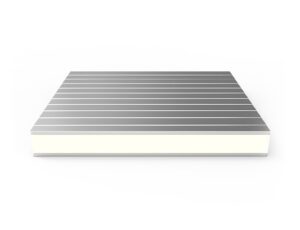
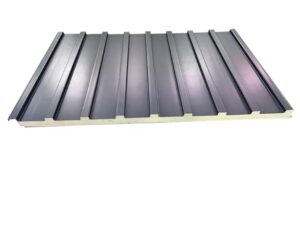
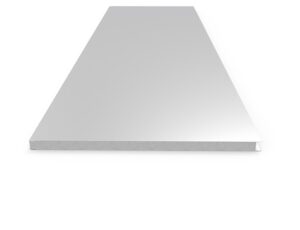
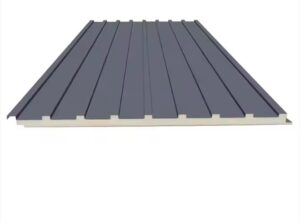
PIR Insulated Sandwich Wall Panels are engineered for operators who measure insulation by what it saves. The polyisocyanurate core conducts heat at just 0.022 W/mK – among the lowest values of any commercial building material – so every square meter of wall, ceiling and partition removes less load from the refrigeration system. Over the thousands of operating hours a cold store accumulates each year, that efficiency translates directly into lower electricity consumption, smaller compressor plants and reduced demand charges, making these panels one of the highest-return investments in any temperature-controlled facility.
Energy-driven specifications appear wherever refrigeration runs continuously: public cold storage warehouses billed on margin per pallet position, food distribution hubs operating three shifts, produce stores running months-long campaigns, and industrial process chillers with 24-hour duty. The panels also serve temperature-controlled production floors in beverage, dairy and confectionery plants where HVAC loads dominate facility energy use. Retrofit projects benefit strongly – replacing or over-lining an aging envelope with PIR panels often cuts room heat load enough to defer new compressor purchases, paying for the envelope work from avoided capital alone.
Consider a 1,000 m² freezer envelope at -25°C in a 30°C ambient. Improving the wall from a U-value of 0.30 to 0.15 W/(m²·K) removes roughly 4.5 kW of continuous heat gain – about 39,000 kWh of refrigeration work per year once compressor efficiency is accounted for. At typical industrial electricity rates, that is thousands of dollars saved annually, every year, for the decades the building stands. The calculation changes with ambient climate, temperature duty and operating schedule, which is why Arteco performs a heat-load comparison for each project rather than quoting thickness from a table. The result is a specification where every millimeter of core purchased converts into measured energy savings, documented before you order.
Continuous double-belt lamination with calibrated foam metering keeps core density at 40 kg/m³ and conductivity at specification across every batch. Panels are cured, cut and inspected for dimensional accuracy, then packed for transport with edge protection. Arteco provides the thermal calculation, layout drawings and joint details, and coordinates panels with doors, floors and refrigeration equipment so the envelope performs as designed from first pull-down.
Savings depend on your current construction, room temperature and ambient climate, but envelope upgrades commonly reduce room heat load by 30–50 percent. Submit your building details through our RFQ form and we will produce a heat-load comparison with quantified savings.
PIR foam maintains its cell structure and conductivity when protected by intact facings and vapor-tight joints. Panels installed with proper sealing hold design performance for decades, which is why the energy case remains valid across the building’s life.
Often, yes. Lower envelope load can allow smaller compressors and condensers on new builds, sometimes offsetting the panel cost premium entirely. We evaluate this trade-off during selection so capital and operating costs are optimized together.
Yes. Panels can line existing masonry or steel structures internally, converting them into cold spaces without external construction work. We detail the interface with existing floors, columns and roof structures in the layout stage.
We provide thermal conductivity data, U-value calculations and product documentation to support energy modeling and certification submissions, coordinated with your project consultants.
Envelope efficiency investments deserve the same financial analysis as equipment purchases, and the data is straightforward to assemble. Start with the building’s envelope area and the temperature each room must hold; combine these with local climate data to calculate annual heat flow through walls, roof and floor at different insulation levels. The difference between constructions is the energy saving – convert it to cost at your electricity rate, and the payback calculation completes itself. Our engineers prepare this comparison for every project where thickness options exist, documenting assumptions so the numbers can be reviewed by your finance team. Facility owners consistently find that envelope decisions made with quantified data outperform decisions made from construction cost alone, because the savings continue accumulating every operating year.
Room dimensions and temperatures, local climate or design ambient conditions, operating hours and your electricity rate. We produce the comparison with documented assumptions for your review.
| Specification | Value |
|---|---|
| Panel Thickness | 40mm, 50mm, 75mm, 100mm, 150mm, 200mm |
| Standard Facings | Steel sheet / Galvanized sheet / Stainless steel |
| Core Material Density | 40 kg/m³ |
| Thermal Conductivity | 0.022 W/mK |
| Acoustic Insulation | 30 dB |
| Standard Length | 2m-12m |
| Effective Width | 1000mm |
| Fire Resistance | Non-flammable |