
One-Stop Cold Storage Solutions: Design, Manufacture & Support
One-Stop Cold Storage Solutions: Design, Manufacture & Support
Category: Sandwich Panels
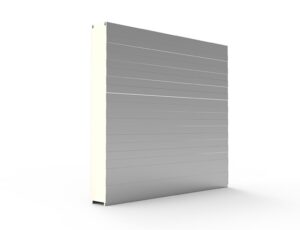
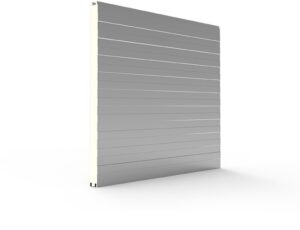
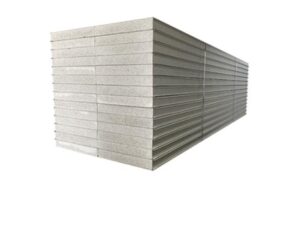
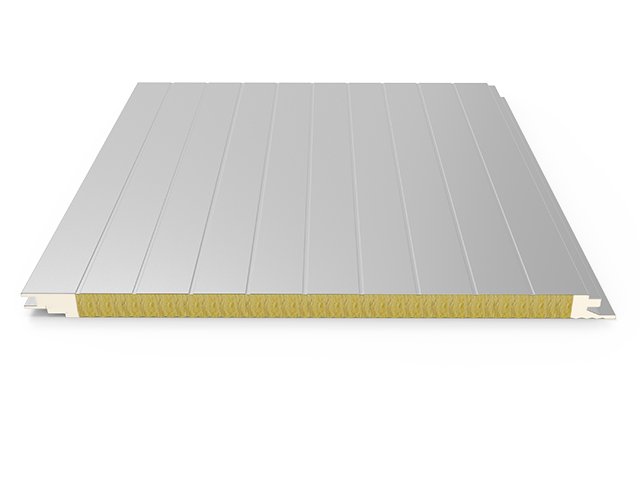
The PU Sealing Glass Wool Sandwich Panel brings together the lightest fibrous insulation available – glass wool – with polyurethane edge sealing that makes it viable in demanding environments. Glass wool’s fine fiber structure absorbs sound exceptionally well and resists fire as a mineral material, while weighing significantly less than rock wool alternatives. The PU sealing closes the fiber edges against moisture, so the panel can serve humid rooms, washdown areas and exterior envelopes without the absorption problems that unprotected glass wool would suffer. Effective width 1000mm and lengths from 2m to 12m suit partitions, enclosures and wall systems where weight, acoustics and fire behavior all matter.
The panel fits rooms where acoustic comfort and fire behavior matter alongside insulation: partitions in food plants separating production from packing and office areas, acoustic enclosures for compressors, fans and generators, clean-area buffer walls in pharmaceutical facilities, temperature-controlled rooms inside regulated buildings, and lightweight insulating linings in retrofits where floor loading is limited. Facilities combining public or office space with plant areas use the panel to achieve acoustic separation without combustible construction.
Both glass wool and rock wool are mineral fibers, and both resist fire in ways foam cannot – but their characters differ, and the choice changes project outcomes. Glass wool’s finer, longer fibers absorb sound more efficiently per unit thickness, making it the acoustic specialist; it is also lighter, easing handling and reducing structural load, which matters in retrofits and upper floors. Rock wool runs denser and hotter-tolerant, suited to fire barriers adjacent to extreme heat sources. Where the requirement is acoustic damping, fire-resistant construction and manageable weight – the common case for partitions, enclosures and plant-room walls – glass wool is the efficient answer. The PU sealing extends its service envelope into humid and washdown environments that would otherwise exclude fibrous cores. Selecting between the two fibers is therefore a question of duty: our engineers recommend the core that matches the room’s actual acoustic, thermal and fire requirements rather than defaulting to either.
Glass wool cores are cut, edge-sealed and bonded to steel facings on controlled lines; panels are inspected for seal continuity, facing adhesion and dimensional accuracy before packing. Arteco prepares layouts with joint details, coordinates panels with doors and penetrations, and provides acoustic and fire documentation to support project approvals.
Glass wool cores run substantially less dense than rock wool equivalents, reducing panel weight significantly per square meter. The saving matters in retrofit linings and large enclosures; we quantify it for your project.
Yes – with PU sealing and steel facings the panel serves exterior envelope duty; joint detailing follows exposure conditions in the layout drawings.
The fiber core absorbs broadband noise effectively, making rooms noticeably quieter across plant and process frequencies. Specific performance depends on panel construction and room geometry; we can discuss acoustic targets during selection.
Yes. Steel facings are cleanable and the sealed core resists moisture ingress; stainless facings are available for aggressive washdown zones.
Glass wool is a mineral fiber that does not sustain combustion; the core resists fire without contributing fuel. Fire documentation for the panel as delivered supports approval submissions.
Acoustic projects succeed when the noise problem is defined before the wall is specified. The starting inputs are the source – which equipment generates the noise, at what levels and frequencies – and the target: the noise limit that applies at the receiving position, whether an office, a public boundary or an occupational exposure standard. Between them, the enclosure must be complete: panel specification, sealed joints, acoustic doors and treated penetrations all contribute, and the weakest element sets the achieved result. Our design process reviews each path – walls, doors, ventilation openings and structural flanking – so the enclosure performs as a system rather than as a collection of panels. Defining the source and target at quotation stage means the specification is engineered to a number, not estimated from material thickness, and the finished enclosure can be verified against it.
Equipment locations and noise data if available, the receiving position and applicable noise limit, and any ventilation or access requirements. We develop the enclosure specification from these inputs.
| Specification | Value |
|---|---|
| Core Material | Glass Wool |
| Properties | Fireproof, thermal insulation, sound absorption |
| Standard Length | 2m-12m |
| Effective Width | 1000mm |